Divorce Made Simple – Save Time, Money, and Stress – Try DivorceWriter Today!
This Article is Part of The Home-Based Writer’s Life Series by msloywrites.

When we get married, most of us aren’t planning for the marriage to end.
We enter the relationship with the hope—and often the expectation—that we will spend the rest of our lives with our partner. We make plans, build a home, create memories, and imagine growing older together.
Divorce is rarely part of that original vision.
However, life… can take some unexpected twists and turns that can leave us broken, bruised and emotionally devastated for years – if we are inflexible or unprepared to face potentially negative relationship outcomes.
When we enter a marriage we must do so with the understandin that circumstances can change, relationships can deteriorate, and issues that once seemed manageable can become impossible to ignore.
Irreconcilable differences, infidelity, financial problems, substance addiction, or domestic violence and abuse can fundamentally change a marriage and leave one or both spouses facing a difficult decision: Is it time to walk away?
For some people, that decision comes after years of trying to save the relationship. For others, it may come suddenly when they discover something about their spouse that changes everything.

Regardless of how a marriage reaches the breaking point, deciding to divorce is only the beginning. The practical process that follows can feel overwhelming—especially when you’re considering filing pro se, or representing yourself without an attorney.
I know this because I have experienced the pro se divorce process firsthand.
As a writer, I’m accustomed to researching information, organizing complicated details, and working through documents.
Even with these advanced administrative skills, navigating the divorce process presented its own challenges. There is a difference between being comfortable with words and knowing which legal documents you need, how to complete them correctly, and what steps come next.
“I went through this myself. I’m a writer, so I naturally researched, documented and organized the process. Here’s what I learned—and here’s a resource I discovered that may help someone facing the paperwork today.”
Michelle S. Loyd – msloydwrites
That experience is what led me to explore resources designed to make the document-preparation side of an uncontested divorce more manageable.
In this article, I’ll share what I learned from my own experience and explain how DivorceWriter may help people who are considering a pro se uncontested divorce and want assistance preparing their divorce documents.
Disclaimer: This article is for informational purposes only and is not legal advice. Every divorce situation is different, and anyone facing complicated legal, financial, custody or safety issues should consider consulting a qualified family-law attorney.
What Does “Pro Se Divorce” Actually Mean?

In Plain English, filing for a pro se divorce means that one or both spouses have opted to become their own legal representative in a divorce filing also known as a dissolution of marriage between you and your current spouse.
Important Note: Filing a pro se divorce is a complex legal process, no easy task and is by far not for the faint of heart.
Managing your own legal case means maintaining keen attention to organizational details required to submit case-related filings, meet important deadlines, and follow up to receive crucial divorce related documentations including divorce decrees.
Long Story Short.
When filing pro se, you are handling your own case, dealing with a local court system and required to follow mandatory legal requirements.
Filing Pro Se: My Personal Experience as a Writer

Reminder: The information provided in this article is based on personal first-hand experience and does not constitute legal advice. ☝🏽
This is a writer’s perspective on navigating pro se divorce and an exploration of how using an online document-preparation service like DivorceWriter can simplify the paperwork process for confused pro se filers.
My personal experience filing for a pro se divorce motivated me to explore easy-to-use resources that could make the administrative side of an uncontested divorce more manageable.
I wanted to better understand the options available should I ever need to navigate the process again. I know myself well enough to say that I will never remain in a situation where I am not treated with equality, fairness, and respect at all times.
As a writer, I am accustomed to researching, organizing information, and communicating clearly—but legal paperwork is an entirely different kind of writing. Initially, I entered the pro se divorce process believing the paperwork would be simple, easy, and manageable.
While I was able to complete the process on my own, I quickly discovered that filing for a do-it-yourself divorce means that the filer is solelyresponsible for carrying out many of the following major legal processes related to divorce filing:
- Researching Legal Requirements
- Deciphering Legal Forms, State Codes, Legal Statutes
- Meeting Court-Appointed Deadlines for Filings and Appearances
- Creating and Filing Motions
- Legal Document Organization
The process can be tedious and time-consuming although I did make it through the entire process and was granted a divorce within a reasonable time frame after filing pro se.
Quick Overview of Divorce Filing Options

Option 1. DIY Divorce = Pro Se or Self-Help Divorce
Filing for a Pro Se Divorce Means That the Petitioner is Responsible for Legal Research, Legal Forms, Submitting Legal Paperwork, Filing Process.
Option 2. Pro Se Filing + Online Document Service Support
Petitioner Responsible for Providing Accurate Divorce-Related Information and Reviewing Prepared Documents from Providers Like DivorceWriter, Following Jurisdiction-Based Filing Instructions.
Option 3. Divorce Filing With Attorney
Legal Advice, Legal Representation, Legal Legworkk Case-Specific Follow-Up, Deadline Management, Document Preparation, Document Filing Are All Handled By Your Attorney or Legal Representative.
Divorce Made Simple – Save Time, Money, and Stress – Try DivorceWriter Today!
The Pro Se Divorce Process: General Overview and What to Expect for DIY Filers

Filing for a pro se divorce means paying attention to small details, being willing to research related state, municipal and county laws, statutes, codes, and documents related to your independent filing. It is a tricky process however many people have successfully completed and filed their own documents. It is important to note that the process will vary between filers based on individual circumstances.
In general, most pro se filers will need to complete the following steps during the process:
Gathering and providing the personal, financial, marital and family information needed to prepare your divorce documents.
Completing the required pro se divorce forms and supporting divorce documents that apply to your circumstances.
Note: Each state has its own requirements for filing.
Pro se filers will need to download or secure a hard copy of your jurisdiction’s divorce packet for pro se filers.
Note: Use a checklist to review your documents to make sure the information is accurate, complete and consistent before submitting to the courts.
Sign and notarize all divorce-related documents and have them notarized when required by your state or court.
Submitting the completed documents to the appropriate City, State, or Municipal Court:and pay any required filing fees.
Note: Most divorce courts offer reduced cost filing options for Pro se filers who are unable to pay their divorce filing fees.
Following your court’s instructions for notifying your spouse, responding to requests and completing any additional requirements until you receive notice that the court is requesting additional information or that the steps to complete your divorce have been finalized.
Awaiting Court Review and Notice of Decision: The court reviews the submitted documents and determines whether the requirements for finalizing the divorce have been satisfied.
Receiving Your Final Divorce Decree: Once the court approves and enters the final order, the marriage is legally dissolved via a divorce decree.
Legal Documents Pro Se Filers May Encounter 📝
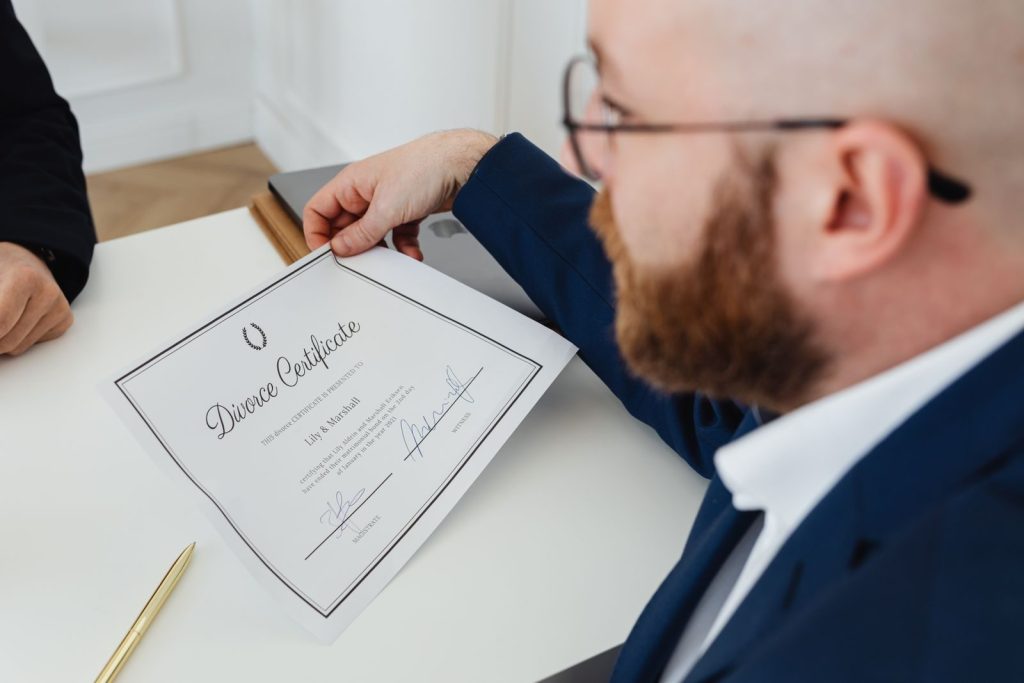
While the exact legal documents required to file and support your pro se claim will vary by state or filing jurisdiction, the following are a few examples of common documents you may encounter when filing for your own divorce.
Petition/Complaint for Divorce: This primary divorce document initiates the case and tells the court what relief the filing spouse is requesting.
Court Summons: This is a formal notice from the court that legally notifies the other spouse that a divorce case has been filed against them.
Answer/Response: A legal document filed by the responding spouse to respond to the divorce filing.
Note: The answer usually states whether they agree or disagree with the divorce – will likely determine if the divorce is contested or uncontested.
Proof/Affidavit of Service: Legal documents that the required papers were properly delivered to the other spouse.
Financial Disclosure/Affidavit: Accurate nformation about income, assets, debts and expenses; the specific requirements differ considerably by jurisdiction.
Marital Settlement Agreement |Separation Agreement: Documents spouses reachimg an agreement around property, debts and support.
Parenting Plan/Custody Agreement — when minor children are involved.
Child Support Worksheet/Order — when applicable.
Spousal Support/Alimony documents — when applicable.
Name Change/Restoration request — when a spouse wants to restore a former name.
Waivers, Stipulations or Consents — depending on the jurisdiction and circumstances.
Various affidavits/declarations — courts may require sworn statements addressing particular facts.
Proposed Judgment/Decree — the document submitted for the judge’s approval in jurisdictions where the parties prepare a proposed final order.
Final Judgment/Decree of Divorce — the court’s final order ending the marriage.
Notice of Entry of Judgment/final-order notice — some jurisdictions issue a separate document confirming that the judgment has been entered. California, for example, specifically identifies this as a separate document from the judgment.
Note: Always refer to your local governing authority for exact rules, laws, document requirements, and filing requirements in your state, and ensure you understand the terms and what steps are required before you file for a pro se divorce.
For an uncontested divorce, the settlement agreement can be particularly important document because it may address property, debts, spousal support, and—where applicable—custody, visitation, and more.
A Few Downsides of Filing Pro Se

The Divorce Paperwork Can Be “Way” More Complicated Than it Looks.
- Finding the correct forms
- Understanding what information belongs where
- Making sure documents are complete
- Keeping track of multiple pieces of paperwork
Conducting Legal Research On Your Own Takes Time and Consumes Tons of Energy.

- What to file
- Where to file
- Filing procedures
- Service requirements
- Court instructions
- What happens after filing
Proper Organization and Storage for Required Legal Documents is Crucial for Processing Success.

- Copies of everything
- Dates and deadlines
- Court correspondence
- Supporting documentation
- Filed paperwork
- Agreements
Professional Writing Skills Help—But Don’t Replace Substantive Legal Knowledge.

Being a professional writer helped me to:
- Read instructions carefully
- Organize information
- Ask better questions
- Maintain documentation
- Communicate clearly
However, being blessed with a strong writing ability doesn’t automatically equate to being a legal expert. 🙏🏽
Is a Filing for a Pro Se Divorce The Right Move for Everyone?

No. Every divorce filing is different and has different circumstances, parameters, and legal requirements. In most cases, filing pro se is a viable option when the following apply.
- Both Spouses Agree That They “Want” A Divorce (THE Most Important Qualifier)
- Both Spouses Agree About Major Issues Including Child Custody and Financial Issues
- Both Spouses Are Willing to Cooperate and Follow The Legal Process
- Both Spouses Have Uncomplicated Financial Status
- Both Spouses Agree to Communicate, Meet Deadlines, Attend Court Appearances Etc.
If Both parties aren’t in agreement filing a pro se divorce is probably NOT the best option for you and can become considerably complicated if your former spouse refuses to cooperate with the divorce process.
Strongly consider getting legal advice or support from a local family law attorney when:

- Both Parties Do NOT Want to Get Divorce = Contested Divorce
- Complicated Financial Issues or Property Issues
- Business Ownership or Related Interest
- Substantial Assets or Wealth Management Concerns Involved
- One or Both Parties Have Retirement Accounts
- One or Both Parties Dispute Child Custody
- Domestic Violence or Coercion Issues
- One or Both Spouses Suspected of Hiding Assets
- Alimony and Spousal Support Disputes
- Other Spouse Simply Refuses to Cooperate with the Divorce Process
Pro se filers should note that the issues listed above can pose serious legal and financial repercussions and will likely require the expert legal guidance or advice of a licensed practicing attorney in your area.
An online document service is NOT a good substitute for an attorney when someone needs individual legal advice.
Learn How DivorceWriter Can Simplify The Pro Se Divorce Process for Writers
What Is DivorceWriter?

DivorceWriter is an Online Document Preparation Service that helps pro se filers complete a simple 3-step process for an uncontested divorce.
What DivorceWriter Does.
The document preparers at DivorceWriter use the information provided by their clients to create and prepare divorce-related documents for pro se filing in their state.
What DivorceWriter “Does NOT” Do.
Document Preparation is NOT The Same Thing as Legal Advice.
People considering filing for pro se divorce and using online document preparation services like DivorceWriter to simplify or expedite the process should note that using DivorceWriter or similar services:
- Does Not Act in Place of a Licensed Local Attorney
- Does Not Represent Filers in Court
- DivorceWriter Services May Include Additional Fees and Costs Outside of Court-Related Costs

How to Use DivorceWriter for Pro Se Filing Support
Step One. Determine If You Qualify for Divorce Document Prep Support.
Services like DivorceWriter can typically help pro se divorce filers simplify the uncontested divorce process when the following scenarios apply.
☐ Is the divorce uncontested?
☐ Are both spouses willing to cooperate?
☐ Have major issues been resolved?
☐ Do you know where you need to file?
☐ Do you understand your state’s basic requirements?
If your situation meets DivorceWriters intake requirements, you can move on to the next step of completing their online questionnaire to provide crucial filing-related information.
Step Two. Gather All Documents and Divorce-Related Details BEFORE You Begin.
- Names of All Parties Involved
- Current and Former Addresses
- Marriage Date, Location, Time, Certificates, Licenses
- Separation information: Dates, Times, Reason for Separation
- Children’s information: Children In Common, Child Support Expectations, Receipts
- Property information: Shared Property, Mortgage Details
- Shared and Individual Marriage Debts, Outstanding Debts, Pending Debt
- Past, Current, Future Anticipated Sources of Income for All Parties
- Existing Custody, Child Support, Alimony, Other Agreement
- Custody – Parenting Details
- Support Documents and Other Relevant Information
Organizing your documents and required information in advance can help reduce submission error and rejection rates which can lengthen the divorce process.
Step Three. Create a DivorceWriter Account Get Help Preparing Your Documents!
Create a DivorceWriter account for access to pre-researched court-ready forms and documents that come with step-by-step filing instructions for your state or jurisdiction. DivorceWriter document support includes addressing some of the most important issues for pro se filers with unlimited changes for a period of up to two years.
Divorce-Related Document Support for: Child Support. Custody. Parenting. Name Restoration. Property Division. Debts.
7 Things I Would Do Differently If I Was Starting a New Pro Se Divorce Filing from Scratch

First of all, choose a different partner. Okay, no. Seriously. I would change the things listed below. 🤭
- Create a Divorce Timeline
- Research My State’s Requirments for Completing, Submitting, and Filing Paperwork
- Gather and Organize All Related Documents
- Make Copies of EVERYTHING
- Keep Court Communications and Records in a Single File or Location
- Learn How to Distinguish Legal Information from Legal Advice
- Consider Document Preparation Assistance to Save Time and Sanity
For someone who has already decided to pursue a pro se divorce, an online document-preparation service may help reduce some of the research and paperwork involved in getting started.
My honest advice is: Don’t underestimate the amount of paperwork research or energy consumed by filing pro se. Also, please avoid making the mistake of assuming every divorce can be handled exactly the same way.
- Get Organized.
- Read Instructions Carefully.
- Don’t Be Afraid to Seek Professional Legal Help When Your Situation Calls for It.
Checklist for Writers Considering Pro Se Divorce

Start Here.
☐ Determine whether your divorce is uncontested
☐ Identify where you need to file
☐ Research basic residency requirements
☐ Gather personal information
☐ Gather financial information
☐ Organize property/debt information
☐ Discuss unresolved issues with your spouse
☐ Determine whether professional legal advice is appropriate
☐ Research document-preparation options
Before You File.
☐ Review every document
☐ Check names and dates
☐ Check addresses
☐ Check financial information
☐ Make copies
☐ Understand filing requirements
☐ Understand service requirements
☐ Know what happens after filing
Frequently Asked Questions

Q1. Can you file for divorce without a lawyer?
Q2. What does pro se mean in a divorce?
Q3. Is an uncontested divorce easier to handle yourself?
Q4. Can you get a divorce online?
Q5. What does DivorceWriter do?
Q6. Is DivorceWriter a law firm?
Q7. Does DivorceWriter file the divorce for you?
Q8. How much does an online divorce cost?
Q9. Do online divorce services include court filing fees?
Q10. When should I hire a divorce attorney?
Considering an Uncontested Divorce?
Find Out if DivorceWriter is a Good Fit for Your Situation.
Divorce Made Simple – Save Time, Money, and Stress – Try DivorceWriter Today!
